Search This Blog

Saturday, September 4, 2010

The Little Angel of St. Louis


[From an image in Stereotaxic Surgery in the Rat: A Photographic Series. Cooley, R.K., and Vanderwolf, C.H., A.J. Kirby Co. London Canada. 2005.]

It must have been around 2001 when I stumbled on the research publications of Dora Angelaki at Washington University School of Medicine in St. Louis. Angelaki means “little angel” in Modern Greek. The Little Angel of St. Louis designs macabre and torturous devices that might be thought of as diabolical carnival rides for monkeys. They aren’t having any fun of course; the thrill is all hers. Angelaki’s scientific motivation is her desire for a mathematical model of postural awareness that accounts for changes in orientation, acceleration, deceleration, and direction and type of motion a monkey is subjected to.

She has built a couple devices with a monkey restraint chair built into them. She calls one the “sled,” and the other the “motion platform.” She uses stainless steel bolts and dental acrylic to fasten a hard plastic ring to the monkeys’ skulls. Bone is very sensitive, so the post surgical pain from such a procedure might be significant, but she makes no mention of whether such a procedure produces pain or lasting headaches in the monkeys. Would she even know?

Then, she drills holes through the monkeys’ skulls. Even in humans, postoperative pain from craniotomies is recognized as moderate to severe and postoperative pain relief often inadequate.

Then, she inserts electrodes directly into their brains.

Then, she sews coils onto the monkey’s eyes. These are scleral search coils, and are used even in experiments with human volunteers. Except, and this is a key point, in the human experiments the scleral coils are built into contact lens-like devices that can be removed at the end of the experiment. The Little Angel sews hers directly to the monkey’s eyes.

Then she mutilates their inner ears.

Then, she straps a monkey into a restraint chair and attaches another device to the ring already bolted to the monkey’s skull. This devise is then bolted in place to the chair. Now the monkey can’t move his or her head.

The lights are turned off and a small dot of light is projected. The monkey is very thirsty because the Little Angel doesn’t allow them any water before the experiment. In similar experiments going on right now around the United States, monkeys are kept very thirsty throughout the week so that they will perform the little tricks that the monsters have taught them. In most cases, this means that the monkey hasn’t had even a sip of water since the previous day.

The she fires up the ride. The monkey can be turned and spun and shaken. If she keeps his eyes fixed on the light, she gets a drop or two of water. And all the while, the Little Angel's computers are recording eye movement and brain neuron firings.

The papers authored by Angelaki rarely mention a possible health need associated with the experiments she conducts. She does not mention how her work might be useful in combating disease or how the results might offer insight into a human malady. Angelaki is interested in mathematical formulae that might model the vestibuloocular reflex (VOR) and the adaptive modifications in an animal’s system following experimental injury. What might bring someone to the point in their life that they would not only contemplate performing such experiments but also actually carry them out, repetitively? Maybe monsters are born monsters.

Here she explains a specific experimental procedure from 1998:
Seven rhesus monkeys were chronically prepared with skull bolts to restrain the head during experiments and implanted with a dual search coil for three-dimensional eye movement recordings using the magnetic search coil technique. Of these, five animals were used for control responses. In addition, data were also collected from five animals after selective semicircular canals were inactivated by plugging. The lateral canals were plugged in two (LC) animals, the right anterior/left posterior canals were plugged in another two (RALP) animals, and all canals were plugged in the fifth animal…. The efficacy of canal-plugging has been histologically verified…. All surgeries were performed under intubation anesthesia, and animal treatment and handling was in accordance with the National Institutes of Health guidelines.

For experiments, the monkeys were seated in a primate chair with their heads restrained in a position such that the horizontal stereotaxic plane was tilted15° nose-down. In this head position, the vertical semicircular canals were approximately perpendicular and the lateral semicircular canals approximately parallel to the earth-horizontal plane. The monkeys were placed in a primate chair that was secured inside a motorized three-dimensional turntable that could deliver both earth-vertical and -horizontal axis rotations about the yaw, pitch, and roll axes. The turntable was surrounded completely by a light-tight sphere (80 cm radius) covered with a random dot pattern such that eye movements could be studied in complete darkness (when the lights inside the sphere were off). This sphere also could be oscillated independently such that horizontal or vertical (but not torsional) optokinetic optic flow could be generated (with the lights inside the sphere on).

Before experimental sessions, animals were given a small dose of d-amphetamine (1.5 mg orally) to maintain a constant level of alertness. Monkeys were subjected to 2 h of simultaneous vestibular and optokinetic oscillations at each of two frequencies….(1)
She could display shapes and lights on the inside of the sphere that a monkey had been trained to follow or affix his or her gaze on. The sphere was on a track and could be accelerated, decelerated, shook, spun, or moved up and down all at the same time.

She’s still at it.

She published three papers in 2008 detailing her experiments on monkeys:

Frequency-selective coding of translation and tilt in macaque cerebellar nodulus and uvula. Journal of Neuroscience, 2008.

Neural correlates of forward and inverse models for eye movements: evidence from three-dimensional kinematics. Journal of Neuroscience. 2008.

A neural representation of depth from motion parallax in macaque visual cortex. Nature. 2008.

Her publications are good examples of the arcane and highly technical jargon that dresses up reports on animal experimentation in a manner that makes it hard for some readers to interpret, or would find hard to interpret if such papers were ever on the newsstand. They aren’t on the newsstands of course, but that’s another matter that might have something to do with monsters’ common and well-known aversion to daylight.

All of her experiments are more or less the same. She turns monkeys into “scientific” instruments. I have to put scientific into quotations because she’s really just torturing animals. She’s just being true to type; she’s just behaving like any monster that is given access to others and the freedom to do to them as it desires.

These are her words from 2006:
Materials and Methods
Subjects and surgery. Physiological experiments were performed in two male rhesus monkeys (Macaca mulatta) weighing 4–6 kg. The animals were chronically implanted with a circular molded, lightweight plastic ring (5 cm in diameter) that was anchored to the skull using titanium inverted T-bolts and dental acrylic… During experiments, the monkey's head was firmly anchored to the apparatus by attaching a custom-fitting collar to the plastic ring. Both monkeys were also implanted with scleral coils for measuring eye movements in a magnetic field... After sufficient recovery, animals were trained using standard operant conditioning to fixate visual targets for fluid reward.

Once the monkeys were sufficiently trained, a recording grid … was fitted inside the ring and … secured to the skull using dental acrylic. The grid was placed in the horizontal plane as close as possible to the surface of the skull. The grid contained staggered rows of holes (spaced 0.8 mm apart) that allowed insertion of microelectrodes vertically into the brain via transdural guide tubes that were passed through a small burr hole in the skull… All animal surgeries and experimental procedures were approved by the Institutional Animal Care and Use Committee at Washington University and were in accordance with National Institutes of Health guidelines.

Motion platform and visual stimuli. Translation of the monkey along any arbitrary axis in 3D space was accomplished using a six degree-of-freedom motion platform. Monkeys sat comfortably in a primate chair mounted on top of the platform and inside the magnetic field coil frame….(2)
In what might be one of her most macabre moments, in a set of experiments she wrote about in 2000, she explained that because she was shaking the monkeys so vigorously, she couldn’t tell with certainty whether the electronics embedded in the monkeys’ brains and eyes were responding to the movements she was measuring or whether the bolts in the monkey’s head weren’t fastened tightly enough to the chair. To assuage her concerns, she cut the monkey’s head off and refastened it to the ride and shook it again:
To investigate the possibility that the head coil did not accurately reflect the movement of the head (e.g., through incomplete coupling or loose head-holder), the following test was performed. Within less than an hour after an animal was euthanized and perfused, the head was put into the superstructure in exactly the same position and was mounted exactly the same way as during experiments….(3)


(1) Angelaki DE, Hess BJ. Visually induced adaptation in three-dimensional organization of primate vestibuloocular reflex. Journal of Neurophysiology. 1998.

(1) Gu Y, Watkins PV, Angelaki DE, DeAngelis GC. Visual and nonvisual contributions to three-dimensional heading selectivity in the medial superior temporal area. Journal of Neuroscience. 2006.

(1) Angelaki DE, McHenry MQ, Hess BJ. Primate translational vestibuloocular reflexes. I. High-frequency dynamics and three-dimensional properties during lateral motion. Journal of Neurophysiology. 2000.

Friday, September 3, 2010

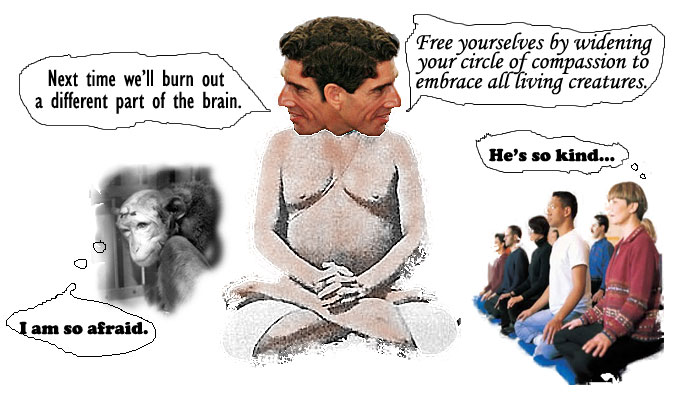
Monsters: Lojong

[An original collage using various images. 2007.]
March 26th, 2008: Can we train ourselves to be compassionate? A new study suggests the answer is yes. Cultivating compassion and kindness through meditation affects brain regions that can make a person more empathetic to other peoples' mental states, say researchers at the University of Wisconsin-Madison.(1)
.....
March 26, 2008: Meditate on This: You Can Learn to Be More Compassionate. A new study shows that meditation opens the gateway to compassion.(2)
.....
October 8, 2008: Data from a new Emory University study suggests that individuals who engage in “compassion meditation” based on a thousand-year-old Tibetan Buddhist mind-training practice (called “lojong” in Tibetan), appears to effectively reduce the inflammatory and behavioral responses to stress that have been linked to depression and a number of physical illnesses. The practice revolves around fostering a sense of heightened compassion for others.(3)


Can we really train ourselves to be compassionate? Maybe. Maybe not. Maybe all of us can’t.

I began reading more or less steadily about Eastern religions and the variety of religious experiences in about 1972, just after my decision to stop hurting animals. I quit eating them and began trying to avoid harming them. Even then I was convinced by the even-then-existing body of evidence that the animals closest to us in evolutionary time and descent are very like us cognitively and emotionally. Darwinian evolution predicts this.

Personal experience substantiated my belief. The insects, lizards, snakes, frogs, and toads I caught seemed less like me than the dogs and cats I knew. And although the dogs and cats I knew were somewhat like each other, they all seemed to have distinct personalities, and they looked back at me when I looked at them.

Certain eastern religions’ positions on the way animals should be treated seem to acknowledge our similarities and the ethical implications that arise from them. Most well known might be Buddhism’s First Precept: Harm no sentient being. This is a response to Buddhism’s First Noble Truth: Life is suffering. Although we are all likely to suffer, we shouldn’t harm each other. In Christianity, this sentiment is expressed in The Golden Rule, though The Golden Rule seems limited to avoiding harm to other humans only.

Buddhism has moved as far astray from Gautama’s teachings as Christianity has moved away from the Sermon on the Mount. Today, people purporting to have discovered evidence that compassion meditation can make one kinder, people who themselves are practitioners of logong, don’t seem to be all that kind and concerned for the happiness of all beings. To at least some, the admonishment about all sentient beings can be matter-of-factly dismissed with an off-hand claim that hurting them is good and right if it might benefit us. I’m reminded of the climax in Stephen King’s Dead Zone when the Hitler-esque politician uses a child to shield himself from a sniper.

All of this has an odd intersection with anxious children.

Researchers at the University of Wisconsin, Madison have identified monkeys with “a ‘trait-like’ characteristic analogous to human behavioral inhibition.” They claim that young monkeys with trait-like anxious temperament (as opposed to all the other monkeys in the lab with learned anxious temperament) are good models of shy children. They say that “because of the similarities between rhesus monkey threat-induced freezing and childhood behavioral inhibition, [their research is] relevant to understanding mechanisms underlying anxious temperament in humans.”
… Our studies have provided evidence for an anxious endophenotype in primates. Monkeys with this temperamental disposition are similar to extremely inhibited children that are at risk to develop anxiety disorders in that they engage in excessive freezing behavior when confronted with a threatening situation. The rhesus monkey is ideal for this work because of similarities in brain structure and social behavior between rhesus monkeys and humans. In addition, compared to other species, rhesus monkeys have a well developed prefrontal cortex allowing for studies aimed at prefrontal-limbic interactions in relation to emotion regulation. The proposed studies will build on our previous work by systematically examining, in rhesus monkeys, the neural circuitry that mediates the regulation of long term anxiety responses. Long term anxiety responses are important because they reflect temperamental dispositions and, when extreme, are characteristic of human psychopathology…(4)
One of these scientists, Dr. Ned Kalin, about whose work the paragraph above was written, has himself written about some of the other similarities between monkeys and humans:
Animals do a lot of things instinctively…. But people—and probably monkeys—have the ability to think 20 steps into the future: “In the end I'm going to feel great, because I worked hard to get there,” or “I'm going to get a lot of credit for this.” It’s the prefrontal cortex that brings those emotions into play and guides us in our behavior. If we didn't have a sense of what would be wonderful or awful in the future, we would behave very haphazardly.(5)
According to the Substance Abuse and Mental Health Services Administration (SAMHSA) (an agency of the U.S. Department of Health and Human Services, anxiety disorders in children come in a variety of forms.

Given the variety of more or less definable types of anxiety disorder in children, the modern view is that these variations are due to the complexity of the brain: the large number of possible neuronal pathways, the complexity of the neurochemistry, and our basic ignorance of the biology of emotion and thought. Anxiety isn’t a uniform emotion with a common cause; it is a set of complex emotions with some similarities – particularly the very basic emotion of fear.

Basic emotions are just that, basic. We don’t need to be fluent, or even slightly informed about someone’s culture and beliefs to recognize their fear. We easily recognize fear in each other, even in other species. Even Seligman recognized fear in the dogs he tortured.

On one of my visits to Africa I was a nursemaid to a rescued young putty-nosed guenon whose mother had ended up in a stew pot. We hung out in the forest for hours on end, him scampering through the trees, investigating flowers, vines, and bugs, and me hoping that a group of monkeys would show up and that he would run off with them. Once when returning to camp, we heard a noise in the treetops coming toward us; we stopped to see what it might be. We watched as a large bachelor male guenon passed overhead. I was quiet and in awe, but my ward jumped from my shoulder and crouched motionless on the path in clear and unmistakable fear. I recognized his emotion in spite of the fact that he was a monkey and I am a man. Fear is a feeling we share.

Fear isn’t fun. Merriam-Webster says that fear is: “an unpleasant often strong emotion caused by anticipation or awareness of danger.” It notes that ‘terror’ is “the most extreme degree of fear” and gives an example of that usage as “immobilized with terror.”

This has all been prelude—background needed to understand the heinous nature of what comes next.

Monsters at the University of Wisconsin, Madison have discovered a way to identify young monkeys that are particularly anxious – like very shy children. They then frighten them – no, they terrorize them – with snakes, humans in lab coats, and unfamiliar adult male monkeys, do experimental brain surgery on them, frighten them again, kill them, and then examine their brains.

One of the monsters that repeatedly puts his name on these experiments is Richard Davidson. He is better known and promoted by the university as a personal friend of the Dalai Lama and a proponent of “compassion mediation,” or lojong. He is the lead author of papers that news articles at the start of this essay are calling attention to. Davidson was named one of Time magazine’s “Most Influential Persons” in 2006. In 2007, Madison Magazine named him Madison’s “Person of the Year.” Neither Time nor Madison Magazine mentioned his experiments on fear using young particularly anxious monkeys. [Original drawing. On the occasion of Richard Davidson being named one of Time magazine’s “100 Most Influential People of 2006.” Click image for a larger version.]

Try to imagine if you can, someone who quotes Einstein in his public lectures on “compassion meditation”:
Our task must be to free ourselves from this prison by widening our circles of compassion to embrace all living creatures and the whole of nature in its beauty,
yet who seeks out the animals with emotions most like our own, the most easily frightened young of those animals, and then frightens them, hurts them, and then kills them. Is it even possible to hold in your mind the conception of an honest human being who holds such divergent views? Davidson tries to sell the idea publicly that sending out waves of love will make you more loving and compassionate and yet defends and embraces experiments terrorizing young monkeys. I can’t reconcile such dramatic logical incongruity; and so, I can only explain someone like this by concluding that they aren’t human.

But it isn’t that Davidson holds grossly inconsistent and contradictory opinions about hurting others that brands him a monster. Davidson and his collaborators are monsters for the same reason that the doctors in my dreams who experimented on Wayne and Gary are monsters.

I wonder what Davidson’s monkeys are actually experiencing?

SAMHSA lists the anxiety disorders of children:
Generalized Anxiety Disorder – Children engage in “extreme, unrealistic worry about everyday life activities.”

Separation Anxiety Disorder – Children have “difficulty leaving their parents to attend school or camp, stay at a friend's house, or be alone.”

Phobias
– Children have “unrealistic and excessive fears of certain situations or objects.”

Panic Disorder – Children have repeated ‘panic attacks’ without an apparent cause.”

Obsessive-Compulsive Disorder – Children “become trapped in a pattern of repetitive thoughts and behaviors.”

Post-traumatic Stress Disorder – Children “experience the event over and over through strong memories, flashbacks, or other kinds of troublesome thoughts.”
Assuming that Kalin and Davidson are correct in their assertion that excessive freezing behavior in threatening situations is similar in young monkeys and human children, and that this temperamental disposition puts them at risk of developing anxiety disorders, just what might the monkeys be experiencing?

Do they worry about what is going to happen to them? Given Kalin’s observation that primates can plan ahead and see into the future, isn’t it likely that exceptionally fearful monkeys might be worried all the time, especially since, and unlike children with a Generalized Anxiety Disorder, really bad things have happened to them and are very likely to happen again?

Are monkeys with an anxious endophenotype more traumatized by the laboratory-typical early separation from their mothers than are the monkeys without this trait? Wouldn’t they be? They are probably all suffering from a Separation Anxiety Disorder.

We can probably rule out Phobias since none of these monkeys’ fears can be fairly called unrealistic or excessive.

And we can rule out Panic Disorder since any episode of panic they have is completely understandable and has a clear cause.

I wonder if these monkeys have an Obsessive-Compulsive Disorder? The only way to find out would be to videotape them to see whether they are behaving like the large number of other monkeys in the labs who have become trapped in a pattern of repetitive behavior. One author lists repetitive behaviors in lab-born monkeys: “body rocking, body twirling, head rolling, head banging, self-clasping, weird limb and body posturing, digit sucking, eye poking and gouging, self-biting, and complex hand movements.”(6) Another source offers this list: bizarre postures, floating limb, self-biting, self-clasping and self-grasping, saluting, stereotyped pacing, head tossing or weaving, bouncing in place, somersaulting, rocking, and a host of others.(7) These lists were made from observations of “normal” monkeys, not the exceptionally fearful animals used by Kalin and Davidson.

And Post-traumatic Stress Disorder? How could these particularly vulnerable young monkeys not be suffering from post-traumatic stress?
… Seventeen animals (15 males and 2 females) underwent lesioning procedures[8] at an average age of 27.9 months. Ten unoperated controls (nine males and one female) were used for comparison and were on average 22.5 months of age at the beginning of the study… Testing. When possible, behavioral tests and physiological data were collected before and after surgery. … Human intruder paradigm. For testing, animals were placed in a cage that was 79 X 76 X 71 cm. The alone condition lasted for the first 10 min that the animal was in the cage by itself. After 10 min, a human entered the room and presented her profile to the monkey, standing 2.5 m from the cage while remaining motionless and avoiding any eye contact with the animal (NEC). The human left the room after 10 min and reentered the room 3 min later for the stare condition (ST). During ST, the intruder remained motionless 2.5 m from the cage while staring with a neutral face, directly at the animal. The human left the room 10 min later… Snake fear testing. To test for snake fear, monkeys were presented with the stimulus box that contained one of four stimuli: (1) nothing (empty box); (2) tape (8.8cm diameter roll of blue masking tape); (3) fake snake (a curled black rubber snake 120 cm in length); and (4) snake (a live northern pine snake, Pithucus melanoleucusi…. The animals were observed to withdraw to the back of the cage when presented with the snake stimuli. Therefore, the number of times animals withdrew during each stimulus presentation was assessed by reviewing the videotapes of each stimulus trial…. Social threat paradigm. The test animal was placed in a large cage partitioned with a transparent plastic divider separating it from a threatening novel adult male rhesus monkey. Exposure to the threatening male lasted 1 hr; the behavioral responses were recorded on videotape for later scoring with a standard scoring system.(9)
So that brings us back to my original question: Can we train ourselves to be compassionate? I suspect that humans can. But not monsters. Apparently, using Davidson as a single data point, no matter how much love they think they are radiating, no matter how they might try to convince themselves that they care about all beings, they simply can’t escape their basic nature. If “compassion meditation” could make a monster be more compassionate, we would expect to see Davidson’s experimental methods become more humane and less invasive over time, but the opposite is the case. He and Kalin are damaging larger parts of monkeys’ brains and subjecting them to grossly more invasive brain surgeries. This suggests that monsters need to be taken off the street, to eliminate them and their morbid influence over the rest of us who struggle with our moral imbecility. Apparently, even if monsters want to be kind, they remain very dangerous and willing to act on their urges to do cruel things to helpless victims.

(1) University of Wisconsin-Madison. “Compassion Meditation Changes The Brain.” ScienceDaily. March 27 2008. http://www.sciencedaily.com­/releases/2008/03/080326204236.htm.

(2) David Biello. “Meditate on This: You Can Learn to Be More Compassionate.” Scientific American, March 26, 2008.

(3) Medical News Today. “Compassion Meditation May Improve Physical And Emotional Responses To Psychological Stress.” October 8, 2008. http://www.medicalnewstoday.com/articles/124680.php

(4) University of Wisconsin, Madison. Waisman Center. Intellectual & Developmental Disabilities Research Center. Project Title: Development and Regulation of Emotion in Primates. Principal Investigator: Ned Kalin, MD. http://www.waisman.wisc.edu/iddrc/project036.html, 2009.

(5) Ned Kalin. Wired For Sadness. Discover. April, 2000.

(6) G. Mitchell. Abnormal behavior in primates. In (Leonard A Rosenblum ed.) Primate Behavior: Developments in Field and Laboratory Research. Volume 1. New York: Academic Press, 1970.

(7) J. Erwin and R. Deni. Strangers in a strange land: abnormal behavior or abnormal environments? In (J. Erwin, Terry L. Maple, and G. Mitchell eds.) Captivity and Behavior: Primates in Breeding Colonies, Laboratories, and Zoos. New York: van Nostrand Reinhold, 1979.

(8) “lesioning procedures” In this set of experiments, Kalin and Davidson injected acid into a deep brain region called the amygdala. There is one on each side of our brain and they are believed to somehow mediate basic emotions. In subsequent studies, their lesioning procedures have become even more invasive. They write
An experienced surgeon made an opening in the frontal bone posterior to the brow ridge to expose the frontal cortex. Both hemispheres were lesioned in a single procedure by lifting the brain to expose its ventral surface. Using microscopic guidance, electro-cautery and suction were applied to the targeted brain area.
From: Role of the primate orbitofrontal cortex in mediating anxious temperament. Kalin NH, Shelton SE, Davidson RJ. Biological Psychiatry. 2007.

(9) Kalin NH, Shelton SE, Davidson RJ, Kelley AE. The primate amygdala mediates acute fear but not the behavioral and physiological components of anxious temperament. Journal of Neuroscience, 2001.

Tuesday, August 31, 2010

Monsters: Monsters and Monkeys

[From an image at AnimalLiberationFront.com]
Ideologues like Mengele can appear to be “cold cynics” in that they need not feel others’ pain if it is in service of a “higher purpose.” They can also have pockets of pragmatism for the same reason—certainly the case with Mengele. Nor is ideological fanaticism incompatible with personal ambition. While Mengele might have been a “good soldier” for the SS (as Dr. B. put it), one who lacked “fake SS ambitions,” we know him to have had very real ambitions that had to do with his ideology and with his overweening desire to become recognized as a great scientist.(1)
“He was a monster, period, no more doctor than anything else, … a monster and … only evil or calamities could come from him.” -- Robert Jay Lifton, quoting an anonymous prisoner doctor.(2)
Josef Mengele, the Angel of Death, is the most notorious of all the Nazi scientists who used human prisoners in their experiments. He is particularly remembered for his research on twins, most of whom were children. He experimented on dwarfs and people with abnormal physical characteristics in general. He studied noma—“a gangrenous condition of the face and mouth…known to result from extreme debilitation,” and eye color. In all these areas, he was particularly desirous of determining genetic factors. Genetics was a watchword used at the time by the Nazi’s to justify their infamous goal of racial purity.

Few if any people today voice a scientific appreciation for Mengele’s research (unlike the praise for J. Marion Simms’) or any of the other research using human prisoners conducted by the plethora of German scientists who did so. But if Germany won the war, history would have painted them in a much different light.

Today, there are a plethora of scientists around the world who use monkeys in their experiments because they believe them to be very like us; not only in a mechanical sense – all primates have a four-chambered heart, for instance – but also mentally and emotionally. Some of them use young monkeys because they believe them to be substantively like human children, mentally and emotionally.

Nearly all scientists who use animals in publicly funded behavioral research and in neurophysiological research on the brain do so because they believe that animals’ brains and behaviors are so similar to our brains and behavior. This is evident and stated clearly in many scientific papers. Not surprisingly, this is particularly true in experiments on monkeys.

This belief – that a human child and a monkey child are so much alike – is what fueled Harry Harlow’s, Steven Suomi’s and Harlow’s many other students’ personal career choices. Stanley Milgram’s work suggests strongly that permission and encouragement by authority accounts for the limits many of us place on our actions. This comports neatly with Lawrence Kohlberg’s stages of moral development. Kohlberg said that morality for most of us is just a matter of doing things that others reward us for doing, or obeying people and institutions we deem to be authorities. If someone like Stephen Suomi had been a Nazi scientist or a doctor in the antebellum south, is it very far-fetched to imagine that he would have been isolating human children in vertical chambers? It is likely that scientists who today use animals because the animals’ emotional responses to the world are very like our own, are members of the same set of personality type that includes Descartes, Magendie, Bernard, Seligman, Harlow, Simms, and Mengele.

It’s hard to know how many people with this personality type – monsters – are active today, but there are at least many thousands. Limiting the group to just those who are using monkeys in publicly funded experiments, or further still, to just those using young monkeys in publicly funded psychological or brain physiology experiments whittles the number down even more. And with the Internet, it’s a matter of only a few keystrokes to gather a rough list.

Dario Maestripieri is a scientist at the University of Chicago. He has received many awards and much encouragement from authoritative scientific institutions. According to his lab’s web page, his areas of research include:

Rodent male and female aggressive behavior
Primate social relationships
Primate communication and cognition
Primate mating systems and reproductive strategies
Primate maternal behavior and offspring development
Primate infant abuse and neglect
Primate behavioral neuroendocrinology
Evolution of animal behavior
Evolution of human behavior, and
Human psychological, physiological, and behavioral adaptations for social processes

Maestripieri’s research on primate infant abuse and neglect is a good example of monstrous behavior. These excerpts are from “Early experience affects the intergenerational transmission of infant abuse in rhesus monkeys,” the report he published in 2005 in the journal, the Proceedings of the National Academy of Sciences of the United States of America (PNAS):
Infant abuse in monkeys shares several similarities with child abuse in humans, including its prevalence in the population, the relation between age and vulnerability to abuse, some psychological characteristics of abusive mothers, and the role of psychosocial stress in triggering abuse. In rhesus and pigtail macaques, infant abuse is concentrated in some matrilines and among closely related individuals such as mothers and daughters or sisters.
The abusive mothers who served as study subjects had been observed in previous years and their abusive behavior had been documented. Only mothers whose frequency and severity of abuse did not jeopardize their infant’s life were used for this study. These abusive mothers were typically consistent in the frequency and severity with which they abused offspring born in successive years.
… the focal sampling method focused on hourly rates of maternal abuse as well as hourly rates of the following maternal behaviors: making contact, breaking contact, cradling, grooming, restraining, and rejecting. Infant abuse was operationally defined as dragging (the mother drags her infant by its tail or leg while walking or running); crushing (the mother pushes her infant on the ground with both hands); throwing (the mother throws her infant a short distance with one hand while standing or walking); hitting (the mother violently slaps her infant with one hand or arm); biting (common definition); stepping or sitting on (the mother steps on her infant with one foot or both feet, or sits on her infant).
The results of this study demonstrate that rhesus macaque mothers who abuse their offspring produce daughters who are likely to become abusive mothers themselves.… In addition, previous studies have shown that macaque mothers who abuse their firstborn offspring continue to exhibit similar patterns of abuse with all of their successive offspring, [He cites three papers to substantiate this claim, all co-authored by him in 1997 and 1998.] thus suggesting that maternal inexperience is not a primary cause of abuse.
Because experimental cross-fostering studies cannot be easily conducted with humans, nonhuman primates provide unique animal models for the study and understanding of the development of human behavior. The availability of a primate model of child maltreatment provides the opportunity not only to conduct research on the causes and consequences of this phenomenon but also to test various forms of intervention and therefore contribute to its prevention.(3)
By at least 1997 or 1998, Maestripieri thought that monkeys who abused their offspring (by dragging, crushing, throwing, hitting, biting, and stepping or sitting on them) would continue to abuse their subsequent children. In 2005, he was still watching and writing about mother monkeys abusing their babies, and continues to do so.

His observations were and are being made at the Yerkes Primate Research Center at Emory University in Atlanta. This matters because the monkeys he has watched and written about live at the whim of the vivisectors there. It is an overt decision by them, and presumably Maestripieri and his co-authors, to allow abusive mother monkeys to keep having babies, and to allow their abused female offspring to also have babies, all of whom they expect will be dragged, crushed, thrown, hit, bit, and/or stepped or sat upon by their mothers. (Presumably, other monkeys at Yerkes are so abusive that they sometimes kill their babies, because as Maestripieri noted in his 2005 paper: “Only mothers whose frequency and severity of abuse did not jeopardize their infant's life were used for this study.”

Given the almost absolute control over the monkeys’ lives that Maestripieri and the Yerkes staff have, we must conclude that the infant abuse that occurs there is not the mother monkeys’ fault. It is the fault of monsters that, knowing full-well what will happen, allow successive generations of abusing mothers to keep having children who will themselves go on to be abusive.

Let’s take a fast tour around the country.

A team of researchers from Yerkes, The Cleveland Clinic, Case Western Reserve University, and Saint Louis University are depriving new-born rhesus monkeys of their vision in one eye:
Two [infant] rhesus monkeys… were monocular vision-deprived by placing an opaque, dark contact lens, in each animal’s left eye. The uniocular contact lens rearing began at birth and extended for two months. The extended wear, gas permeable lens was replaced on a daily basis with a like sterilized opaque contact lens. Three [infant] rhesus monkeys… were vision-deprived in the left eye at birth by tarsorrhaphy and were observed for four months.(4)
Tarsorrhaphy is the medical term for sewing the eyelids almost shut.

At the Washington National Primate Research Center at the University of Washington in Seattle, Gene Sackett, one of Harlow’s students, reports that monkeys placed at birth in a torture apparatus are severely impaired months later. Now we know.
The study described here is the first to experimentally demonstrate the effects of experience on the development of tactual-visual transfer. Infant pigtailed macaque monkeys (Macaca nemestrina) were reared from birth to 2 months of age in special cages that allowed the separation of tactual and visual experience. When assessed on a battery of measures at the end of the 2-month period, animals reared without the opportunity to integrate information across the two sensory modalities performed at chance levels on a paired-comparison measure of tactual-visual transfer and performed worse than controls in a visually guided reaching task. After living in the standard laboratory environment for 2 additional months, they were reassessed. While their visually guided reaching now no longer differed from that of controls, they continued to perform at chance on the tactual-visual transfer assessment and their performance on this task was significantly worse than the control groups… The results are discussed in terms of a possible sensitive period during which specific environmental input is required for the development of normal tactual-visual cross-modal processing.(5)
[Held R, Bauer JA Jr. Visually guided reaching in infant monkeys after restricted rearing. Science. 1967.]

This image shows that Sackett et al are wrong about their cruelty being the first of its type, and the sort of thing that the Washington monsters have been doing to the baby monkeys. It’s quite evil.

Vivisectors at the hidden but gigantic FDA complex known as the National Center for Toxicological Research in Jefferson, Arkansas, have been intravenously infusing pregnant mothers and infants with ketamine for 24 hour-long periods. Ketamine is a PCP relative that the National Institute of Drug Abuse describes like this:
Ketamine is a dissociative anesthetic, so called because it distorts perceptions of sight and sound and produces feelings of detachment from the environment and self. Ketamine acts on a type of glutamate receptor (NMDA receptor) to produce its effects, similar to those of the drug PCP. Low-dose intoxication results in impaired attention, learning ability, and memory. At higher doses, ketamine can cause dreamlike states and hallucinations; and at higher doses still, ketamine can cause delirium and amnesia.(6)
At the University of California, San Francisco, monsters are severing the largest of the muscles that control eye movement.(7) They are doing this to newborn infant monkeys. Then, when they are between three and four years old, they attach a titanium post to their skull. Then they restrain their heads and record their eye movements. Although they are unsure whether they used two or three monkeys in this experiment, they are certain that the monkeys’ damaged eyes were able to track less well than their undamaged eyes.

Monsters at University of Wisconsin’s Harry Harlow Laboratory of Primate Psychology continue to churn out an endless string of papers detailing the effects of exposing pregnant monkeys to alcohol.
METHODS: The offspring of monkeys who did or did not consume moderate amounts of alcohol during pregnancy were assessed for temperament as neonates … in response to mother-infant separation at 6 months of age… RESULTS: Prenatal alcohol exposed carriers of the s allele exhibited increased neonatal irritability…(8)
Here’s a paper from the NIH National Animal Center in Poolesville, Maryland. It’s another Suomi publication, but the title caught my eye, so I thought I’d include it here as part of the tour:
…The purpose of this study was to examine the effects of three rearing conditions on biting behavior and to determine whether early infant behavior can predict later self-biting. The subjects were 370 rhesus macaques born at the National Institutes of Health (NIH) Animal Center between 1994 and 2004. They were reared under three conditions: mother-reared in social groups [183 monkeys], peer-reared in groups of four [84 monkeys], and surrogate-peer-reared [103 monkeys]. Significantly more surrogate-peer-reared animals self-bit compared to peer-only or mother-reared animals… In the play-group situation, surrogate-peer-reared subjects who later self-bit were found to be less social and exhibited less social clinging than those that did not self-bite… Our findings suggest that surrogate rearing in combination with lower levels of social contact during play may be risk factors for the later development of self-biting behavior.(9)
This paper, “Early predictors of self-biting in socially-housed rhesus macaques (Macaca mulatta),” was published in 2007. Suomi has been observing and reporting on the devastating effects of maternal deprivation since 1970; he’s still at it almost 40 years later.

Here’s another dose of evil from Yerkes:
…in absence of their biological mother, infant primates form attachment to surrogate mothers. Although, this early attachment is critical for the development of normal species-typical social and emotional skills, the neural substrates underlying the formation of social relationships in primates are still unclear. The present study assessed, in infant rhesus monkeys (Macaca mulatta) reared by human caregivers and social interactions with peers, the effects of bilateral neonatal (1-2 weeks of age) ibotenic acid lesions of the amygdala and hippocampus (N=6 in each group), aspiration lesions of the orbital frontal cortex (N=6) or sham lesions (N=5) on the development of a social attachment with the principal human caregiver.(10)
Get it? They took very young monkeys from their mothers and then injected acid into various areas of their brains. The monsters wanted to know how this affected their social attachment to the person caring for them. (This reminds me of my nightmares about the doctors and the nurses “caring” for my junior high school friends Wayne and Gary as they crippled their legs.) They conclude:
The present non-human primate findings are discussed in terms of their relevance for autism.
Mark J. Nijland is a vivisector at the University of Texas Health Science Center in San Antonio, Texas. He has spent a number of years studying the effects of various insults to developing sheep fetuses. He has recently branched out to monkeys in a series of experiments being funded by the NIH National Institute of Child Health and Human Development (the same outfit that Suomi works for.) In his new work, he is studying one of what must be a myriad of fetal developmental results of “nutrient restriction” in developing baboons. Here’s his explanation for a lay audience (you and me):
Lay Description: We pass more biological milestones before we are born than at any other time in life. Our data will develop what is know [sic] about kidney development in the primate and demonstrate that sub-optimal conditions in utero alter the trajectory of renal development. Clinicians will use the information to understand optimal life style and diet in pregnancy.(11)
It looks like he’s simply being paid to demonstrate a known fact.

A colleague of his at the University of Texas Health Science Center, Thomas J. McDonald, is being funded to study the effect of a 30% “maternal nutrient restriction” on developing baboon brains, the same as Nijland’s reduction. Maybe they are using the same baboons. McDonald says:
… the fact that much of brain development that goes on during gestation (G) in primates occurs postnatally in laboratory rodents is a clear disadvantage in rodent models. In addition, it is important to emphasize a point made by Rice and Barone that “... both the visual and auditory systems of albino animals of all species are abnormal; therefore, albino rats or mice are a poor choice for assessment when the nervous system is of interest.” This very important caveat makes it imperative that observations made in rats be confirmed in a primate model prior to assuming applicability to humans. The present application looks at the effects of 30% maternal (M) nutrient restriction (NR) on fetal brain development in a primate model, the baboon. The paradigm does not produce weight loss in the fetus; however as will be shown, it does produce dramatic reductions in many parameters in the developing brain. In addition, our 30% MNR paradigm reduces fetal blood urea nitrogen thus suggesting fetal NR and demonstrating that body weight is a very poor indicator of fetal NR. We have chosen to look at the frontal cortex since it is an area of the brain that has been shown in rodent models to be adversely affected by even relatively mild (isocaloric, two thirds less protein) nutrient restriction and we wish to determine if a similar result will be seen in a primate model. In addition, we believe that NR effects in this area will be mirrored by detriments in other areas such as the cerebellum and accordingly, we will retain other brain areas for future studies. Investigations of this type cannot ethically be done in humans; this fact makes studies in a model with a brain that is similar to humans such as the baboon, all the more urgent.(12)


What’s urgent is that monsters like Nijland and McDonald stop and desist. Who doesn’t know that pregnant mothers, pregnant mice, sheep, monkeys, and humans need an optimal diet to deliver as healthy and robust a child as possible? Do we need to know the arcane biochemistry of isolated organs affected by sub-par nutrition? Only a monster could dream up such meaningless cruelties and them scheme to have taxpayers foot the bill.

We could keep going, but the facts are clear. All over the U.S. animals are in the clutches of very callous and cold vivisectors, who like their monstrous predecessor, Claude Bernard, cannot hear the animals’ cries.


(1) Robert Jay Lifton. The Nazi Doctors: Medical Killing and the Psychology of Genocide. New York: Basic Books, 1986.

(2) Ibid.

(3) Dario Maestripieri. Early experience affects the intergenerational transmission of infant abuse in rhesus monkeys. Proc Natl Acad Sci U S A. 2005.

(4) Georgiana Cheng, Henry J. Kaminski, Bendi Gong, Lan Zhou, Denise Hatala, Scott J. Howell, Xiaohua Zhou, Michael J. Mustari. Monocular visual deprivation in Macaque monkeys: A profile in the gene expression of lateral geniculate nucleus by laser capture microdissection. Molecular Vision. 2008.

(5) Batterson VG, Rose SA, Yonas A, Grant KS, Sackett GP. The effect of experience on the development of tactual-visual transfer in pigtailed macaque monkeys. Developmental Psychobiology. 2008.

(6) National Institutes of Health. National Institute on Drug Addiction. “NIDA InfoFacts: Club Drugs (GHB, Ketamine, and Rohypnol).” http://www.drugabuse.gov/InfoFacts/clubdrugs.html

(7) Economides JR, Adams DL, Jocson CM, Horton JC. Ocular motor behavior in macaques with surgical exotropia. Journal of Neurophysiology. 2007.

(8) Kraemer GW, Moore CF, Newman TK, Barr CS, Schneider ML. Moderate level fetal alcohol exposure and serotonin transporter gene promoter polymorphism affect neonatal temperament and limbic-hypothalamic-pituitary-adrenal axis regulation in monkeys. Biological Psychiatry. 2008.

(9) Lutz CK, Davis EB, Ruggiero AM, Suomi SJ. Early predictors of self-biting in socially-housed rhesus macaques (Macaca mulatta). American Journal of Primatology. 2007.

(10) Goursaud AP, Bachevalier J. Social attachment in juvenile monkeys with neonatal lesion of the hippocampus, amygdala and orbital frontal cortex. Behavioural Brain Research. 2007.

(11) Grant Number: 5P01HD021350-170003 (funded for 2008.)

(12) Grant Number: 5P01HD021350-170002 (funded for 2008.)

Monday, August 30, 2010

Monsters: Learned Helplessness Inescapable Electrical Shock

[From a random image of a depressed dog gleaned from the Internet.]

I began researching Martin Seligman’s experiments on dogs in 2003 for a (unpublished) book I was working on. While working on the present essay, I happened upon a statement by Dr. Seligman in The Daily Pennsylvanian (“the University of Pennsylvania's independent student newspaper”) from 2008.

He sums up his position:
Forty years ago, several dozen dogs got 64 brief shocks that were moderately painful. From the knowledge that was gained, depression was relieved for hundreds of thousands of people. Inflicting pain on animals or humans in medical experiments can only be justified if it is likely that the knowledge gained will eliminate vastly more suffering.

This is what I believed then, and what I still believe today.(1)
“[S]everal dozen dogs got 64 brief shocks that were moderately painful.” What’s the big deal?

I find it impossible to escape from my dreams about Gary and Wayne. When I call to mind the scenes of them in some nominally hospital-like room, a doctor-like person examining their crippled legs and discussing in a very calm voice just what they were planning to do in the next surgery and what the effects might be, and my friends’ pain and hopelessness, the same strong visceral twisting of my gut is as real now as when I would awaken and worry about going back to sleep lest I return to that “hospital.”

The cold, unflinching repetition of torture is a hallmark of a monster.

Several dozen dogs. More than a dozen dozen, actually. Treating even one dog the way Seligman did would be monstrous.

“64 brief shocks that were moderately painful.” What’s the big deal?

Seligman reported that his observations were based on over 150 dogs.
When an experimentally naive dog receives escape-avoidance training in a shuttle box, the following behavior typically occurs: at the onset of the first traumatic electric shock, the dog runs frantically about, defecating, urinating and howling, until it accidentally scrambles over the barrier and so escapes the shock. On the next trial, the dog, running and howling, crosses the barrier more quickly than on the preceding trial. This pattern continues until the dog learns to avoid shock altogether. Overmier and Seligman (1967) and Seligman and Maier (1967) found a striking difference between this pattern of behavior and that exhibited by dogs first given inescapable electric shocks in a Pavlovian hammock. Such a dog’s first reactions to shock in the shuttle box are much the same as those of a naive dog. In dramatic contrast to a naive dog, however, a typical dog which has experienced uncontrollable shocks before avoidance training soon stops running and howling and sits or lies, quietly whining, until shock terminates. The dog does not cross the barrier and escape from shock. Rather, it seems to give up and passively accepts the shock. On succeeding trials, the dog continues to fail to make escape movements and takes as much shock as the experimenter chooses to give.(2)
Now, Seligman in the The Daily Pennsylvanian, quoted below, should be read with some skepticism, because “this brings us to an obvious but mostly overlooked weakness in the vivisector's position: that is, his inevitable forfeiture of all claim to have his word believed. It is hardly to be expected that a man who does not hesitate to vivisect for the sake of science will hesitate to lie about it afterwards to protect it from what he deems the ignorant sentimentality of the laity.” (The Doctor's Dilemma, Getting Married, and The Shewing-up of Blanco. George Bernard Shaw. 1911.)
I arrived at Penn as a graduate student in psychology in 1964, when Richard Solomon's laboratory was doing experiments with electric shocks and dogs. Dogs that received 64 brief inescapable shocks became passive, and this seemed to me a likely model of human helplessness and depression.
So we have to understand Seligman from the position of someone who willingly entered and became part of a vivisectionist’s lab. He wasn’t ordered to do it, like a Nazi soldier or a U.S. reservist at Abu Ghraib, people who were simply easily led, he apparently sought out Solomon’s lab.
As excited as I was by the possibilities of this discovery, I was dejected about something else.

Could I work in a laboratory that gave shocks to perfectly innocent animals? I have always been an animal lover, particularly a dog lover, so the prospect of causing pain - if only minor and temporary pain - was very distasteful. I shared my doubts with one of my philosophy teachers (who went on to become one of the world's leading philosophers), Robert Nozick.
Minor and temporary, he says. But this was written after the fact. He had already explained forty years earlier that: “at the onset of the first traumatic electric shock, the dog runs frantically about, defecating, urinating and howling,” and that “On succeeding trials, the dog continues to fail to make escape movements and takes as much shock as the experimenter chooses to give.”
“I've seen something in the lab that might be the beginning of understanding helplessness,” I started out. “No one has ever investigated helplessness before, yet I'm not sure I can pursue it, because I don't think it's right to give shocks to dogs. Even if it's not wrong, it's repulsive.”

“Marty,” Bob asked, “do you have any other way of cracking the problem of helplessness?” It was clear to both of us that case histories of patients were a scientific dead end. It was equally clear that only well controlled experiments could isolate cause and discover cure. Further, there was no way I could ethically give shock to human beings. This seemed to leave only experiments with animals.

“Is it ever justified,” I asked, “to inflict pain on any creature?” Bob reminded me that most human beings, as well as household pets, are alive today because animal experiments were carried out. Without them, he asserted, polio would still be rampant and smallpox widespread.

“Let me ask you one thing about what you propose to do,” Bob said finally. “Is there a substantial chance that you will eliminate much more pain in the long run than the pain you cause in the short run?”

My answer was “yes.”
Maybe Seligman remembers this more-than-four-decade-old conversation accurately, but one has to wonder given the fact that Robert Nozick is remembered for his 1974 book Anarchy, State, and Utopia, in which he argues at length that ethical treatment of animals isn’t adequately defined by such utilitarianism. Nozick writes:
[I]sn’t utilitarianism at least adequate for animals? I think not. But if not only the animals’ felt experiences are relevant, what else is? Here a tangle of questions arises. How much does an animal's life have to be respected once it’s alive, and how can we decide this? Must one also introduce some notion of a nondegraded existence? Would it be all right to use genetic-engineering tech­niques to breed natural slaves who would be contented with their lots? Natural animal slaves? Was that the domestication of ani­mals? Even for animals, utilitarianism won't do as the whole story, but the thicket of questions daunts us.(3)
Unfortunately, Robert Nozick died in 2002, so we can’t ask him.

Robert Seligman, on the other hand is alive and well. His current shtick is the promotion of happiness; go figure.

This is from the University of Pennsylvania website:
Dr. Martin Seligman is the Director of the University of Pennsylvania Positive Psychology Center and founder of Positive Psychology, a new branch of psychology which focuses on the empirical study of such things as positive emotions, strengths-based character, and healthy institutions. His research has demonstrated that it is possible to be happier — to feel more satisfied, to be more engaged with life, find more meaning, have higher hopes, and probably even laugh and smile more, regardless of one’s circumstances. Positive psychology interventions can also lastingly decrease depression symptoms. The research underlying these rigorously tested interventions is presented in the July/August edition of the American Psychologist, the journal of the American Psychology Association.

Authentic Happiness has almost 700,000 registered users around the world.
Maybe Seligman has turned over a new leaf. Let’s hope so. But he hasn’t come close to apologizing for the things he has done or the lives he destroyed (from The Daily Pennsylvanian):
From the knowledge that was gained, depression was relieved for hundreds of thousands of people. [Actual improvement of symptoms of depression is almost entirely due to a serendipitous discovery that resulted from the treatment of tuberculosis in the early 1950s.(4) The resulting pharmacological revolution had no connection to Seligman’s experiments.] Inflicting pain on animals or humans in medical experiments can only be justified if it is likely that the knowledge gained will eliminate vastly more suffering.

This is what I believed then, and what I still believe today.
But what he did was monstrous.
[I]t is not an accident that we have used the word “helplessness” to describe the behavior of dogs in our laboratory. Animals that lie down in traumatic shock that could be removed simply by jumping to the other side, and who fail even to make escape movements are readily seen as helpless. Moreover we should not forget that depressed patients commonly describe themselves helpless, hopeless, and powerless.(5)
And even if what he did was monstrous, he did it 40 years ago, right? So what’s the big deal? Yet others, who have been accused of arguably lesser crimes from 60 years ago, are being brought to justice. A March 2009, Associated Press story (Nazi war crimes suspect loses extradition appeal) reported that: “Charles Zentai is accused of beating to death teenager Peter Balazs in 1944 in Budapest while serving as a soldier in the army of his native Hungary, then allied with Adolf Hitler's Nazi Germany.”

Beating a teenager to death is certainly a serious crime, but it has to be evaluated in light of Stanley Milgram’s famous discovery that the weight of authority is too often sufficient to compel us to hurt others. In a letter dated 1961, Milgram wrote to Henry Riecken, head of Social Sciences at the National Science Foundation:
The results are terrifying and depressing. They suggest that human nature—or more specifically, the kind of character produced in American society—cannot be counted on to insulate its citizens from brutality and inhumane treatment at the direction of a malevolent authority. In a naïve moment some time ago, I wondered whether in all of the United States a vicious government could find enough moral imbeciles to meet the personnel requirements of a system of death camps, of the sort that were maintained in Germany. I am now beginning to think that the full compliment could be recruited in New Haven. A substantial proportion of people do what they are told to do, irrespective of the content of the act, and without pangs of conscious, so long as they perceive that the command comes from a legitimate authority.(6)
Charles Zentai may be guilty of being swept up in the Nazi frenzy and following orders and as a result committing what is now viewed as a crime, but this is much different than simply heading out on his own and beating people to death. There is a fundamental difference between a "moral imbecile," as most of are wont to be at times, and monsters, who proceed independently, without outside direction to torture and murder others.

If Zentai should be held to account for killing one boy, while perhaps following orders to do so, then so too must someone who tortured 150 dogs and other animals so severely.

We can’t leave Seligman without thinking about his recollected conversation with Robert Nozick. Seligman claims to recall that Nozick said that “most human beings, as well as household pets, are alive today because animal experiments were carried out. Without them, polio would still be rampant and smallpox widespread.” But this is pure unadulterated bunk; how handy it would be if it were correct.

All epidemic diseases ebb and flow. Whether or not polio ebbed because of polio vaccinations is not as clear as it might seem. Polio wasn’t ever really “rampant.” Heart disease and cancer account for over 40% of the deaths that occur in the U.S. In 1952, at the peak of the polio epidemic in the U.S., 3,145 died from complications related to the disease. This is a lot of people, but polio doesn’t even make the 1952 (or any other year’s) top ten list of the leading causes of death.(7) Polio was hyped only because President Roosevelt had the disease.(8) Polio research got funded while the real killers were left largely ignored. Most human beings are not alive today because animal experiments were carried out during the development of the polio vaccine. Seligman is wrong.

How about smallpox? A readable and informative book on the topic is Jennifer Lee Carole’s 2003 novelized science history, The Speckled Monster: A Historical Tale of Battling Smallpox. In short, a British woman who had herself survived smallpox, as most people did, accompanied her husband to his post as the British Ambassador to the Ottoman Empire. In Turkey, she learned of the practice of inoculation against small pox. She carried the practice home with her to England where it was tried and written about, which led to its introduction in America.

Edward Jenner, credited with the invention of vaccination, had himself been inoculated against smallpox the old fashioned way, with a small bit of the pus from a smallpox lesion being placed into a small intentional wound. This practice, called variolation, was becoming fairly widespread and accepted by the time Jenner began trying vaccination as a safer less-stressful alternative.

Moreover, Jenner didn’t conduct animal experiments. He wondered why milkmaids didn’t seem to be as susceptible to small pox as other people. He had been inoculating people with pus from lesions on smallpox victims, but tried using pus from lesions on the hands of a milkmaid. The people he tried the new procedure on were his experimental subjects.(9)

Any claim that “animal experimentation” led to the small pox vaccination is woefully uninformed or intentionally misleading. Seligman is wrong again. Monsters dearly want people to accept as “a necessary evil” the tortures they visit on their victims. They can’t be trusted. They can’t be believed.

[Post script: "War on terror" psychologist gets giant no-bid contract The Army has handed a $31 million deal to Dr. Martin Seligman, who once blasted academics for "forgetting 9/11." By Mark Benjamin on Salon.com]

(1) Martin Seligman. Opinion: “Data that opens countless doors” (Counterpoint). The Daily Pennsylvanian. August 7, 2008.

(2) Seligman, M.E. “Depression and Learned Helplessness.” In (R.J Friedmand and M.M. Katz Eds.) The Psychology of Depression: Contemporary Theory and Research. Washington D.C.: V.H. Winston and Sons, 1974.

(3) Robert Nozick. Anarchy, State, and Utopia. New York: Basic Books, 1974.

(4) Crane G.E. The psychiatric side-effects of iproniazid. American Journal of Psychiatry. 1956.

(5) Seligman, M.E. “Depression and Learned Helplessness.”

(6) Thomas Blass. The Man Who Shocked the World: The Life and Legacy of Stanley Milgram. New York: Basic Books, 2004.

(7) “Leading Causes of Death, 1900-1998.” Centers for Disease Control. http://www.cdc.gov/nchs/data/dvs/lead1900_98.pdf

(8) David M. Oshinsky. Polio: An American Story. New York: Oxford University Press, 2005.

(9) Jennifer Lee Carole. The Speckled Monster: A Historical Tale of Battling Smallpox. New York: Plume, 2003.

Sunday, August 29, 2010

Monsters: Harry Harlow and Stephen Suomi

[From a photograph by Jack Smith/AP. In a November 14, 2007 article in National Geographic News, “Monkey Embryos Cloned, Scientists Report,” reprinted from an article by Malcolm Ritter in New York, published by the Associated Press. The caption reads: “Two rhesus monkeys—born of DNA taken from cells of developing monkey embryos—huddle together at a research center in Oregon in 1997.”]
We also discovered that 12 months of total social isolation from birth had even more drastic effects than 6 months [of total social isolation] on behavior in the playroom. Exploration and even simple play were nonexistent. Torn by fear and anxiety, aggression was obliterated in these monkeys, and even the simple pleasure of onanism [male masturbation] was curtailed. They sat huddled alone in the corners or against the walls of the room. The actual experiment was stopped after 10 weeks, since the control animals were literally tearing up the 12-month isolates, and the isolates themselves made no effort to protect themselves. These animals were maintained for many years and never demonstrated any vestige of virginal social ability…

A considerable number of our isolate-reared females were eventually impregnated by patient and competent feral males. When adequate animal assistance failed, we resorted to an apparatus that restrains, positions, and supports the female during copulation. Very soon we discovered that we had created a new animal—the monkey motherless mother. These monkey mothers that had never experienced love of any kind were devoid of love for their infants, a lack of feeling unfortunately shared by all too many human counterparts. Most of the monkey motherless mothers ignored their infants, but other motherless mothers abused their babies by crushing the infant’s face to the floor, chewing off the infant’s feet and fingers, and in one case by putting the infant’s head in her mouth and crushing like an eggshell. Not even in our most devious dreams could we have designed a surrogate as evil as these real monkey mothers. Harry F. Harlow and Clara Mears (1)
-----
... the lab team built what Harry called evil or “monster” mothers. There were four of them and they were cloth moms gone crazy. All of them had a soft-centered body for cuddling. But they were, all of them, booby traps. One was a “shaking” mother who rocked so violently that, Harry said, the teeth and the bones of the infant
rattled in unison. The second was an air-blast mother. She blew compressed air against the infant with such force that the baby looked, Harry said, as if it would be denuded. The third had an embedded steel frame that, on schedule or demand, would fling forward and hurl the infant monkey off the mother’s body. The fourth monster mother had brass spikes (blunt-tipped) tucked into her chest; these would suddenly, unexpectedly push against the clinging child. Deborah Blum.(2)
Harlow’s similarity to Dr. Cadman, Dr. Frankenstein, and Dr. Moreau is hard to miss. On one level, they made monsters, but of course, they were the real monsters. Harlow’s case is particularly evil. Dr. Cadman was trying to save his wife; Dr. Frankenstein was trying to imbue life into dead tissues, but Harlow’s purposes were trivial, and thus more monstrous.

No vivisector has been more defended than Harlow. The consistent claim of his defenders is that before Harlow demonstrated an infant’s need of nurturing, the medical profession was telling parents not to hug or express love to their children, and they didn’t. In the final paragraph of her novel-length paean to Harlow, fellow University of Wisconsin, Madison professor Deborah Blum writes:
And since we—psychology as a profession, science as a whole, mothers and fathers and all of us—didn’t fully believe [that babies need “companionship,” a ‘caring mother,” and need to be “scooped up into someone’s arms and reassured that the day is going to be alright”] before Harry Harlow came along, then perhaps we needed—just once—to be smacked really hard with that truth so that we could never again doubt. Let us remember the best of Harry’s contributions as well as the worst.(3)

But there is no “best” to remember. Harlow was a monster. He conducted macabre and hideously cruel experiments on baby monkeys because he expected them to respond just as everyone knew human children would have responded. There was no doubt that, in spite of Deborah Blum’s claims to the contrary, essentially everyone did indeed already “fully believe.”

Psychiatrist and psychoanalyst René Spitz (1887-1974) began his observational studies on large populations of human children in the 1930s. He described in great detail the contrasting effects of being raised with or without a nurturing caregiver. He termed the results of maternal and emotional deprivation anaclitic depression or hospitalism. He reported that children raised without emotional warmth were retarded physically and emotionally.(4)

Blum, like others who defend Harlow asserts that prior to Harlow’s studies, parents were taught to maintain a hands-off approach lest they spoil their children. Parents were taught, Harlow’s defenders assert, to let the baby cry, not to pick her up, and not to coddle her.

There was a time when doctors promoted this line of thinking, but in 1946 pediatrician Benjamin Spock published The Common Sense Book of Baby and Child Care, which became an instant bestseller and is widely acknowledged to be the most influential source on childcare ever written. Microsoft Encarta notes that it “sharply redefined the course of child care during the baby boom after World War II.”

Here’s an excerpt from a March 16, 1998, The NewsHour with Jim Lehrer interview on the occasion of Dr. Spock's death. Dr. Stephen Parker is co-author of Dr. Spock's Baby & Child Care.

ELIZABETH FARNSWORTH: Were his ideas resisted, or were they pretty quickly adopted?

DR. STEVEN PARKER: Well, they were resisted by professionals, who, I think, had a vested interest in the advice [they] had been giving for the last twenty or thirty years. And this is quite different. But it was embraced by parents immediately in droves at a level that people had never anticipated. [My emphasis]

ELIZABETH FARNSWORTH: We just heard a little bit about the way he thought. Tell us more about his ideas and what was new and what was really important in them.

DR. STEVEN PARKER: Well, to really understand the success and impact of Dr. Spock you have to remember the context in which he burst upon the scene. Child-rearing advice at the time was an incredibly dismal affair. Parents were told don't touch your child, don't kiss them, don't hug them, feed them on a schedule, let them cry, prepare them for a tough world by not being emotionally involved. And he came to it saying, well, wait a second, trust yourself. No parent inherently feels that way. Do what feels right for you, and you probably won't go wrong. And he based it too on his ideas of the understanding of child development, which included the importance of attachment and the emotional relationship between parent and child, and most of all, children needed to feel loved. And if they felt loved, almost everything else would follow from there. That was revolutionary in 1946, believe it or not.

John Bowlby was commissioned by the World Health Organization (WHO) to study the mental health of children who were “homeless in their native country” in post-war Europe. His report, Maternal Care and Mental Health, was published by the WHO in 1950. High demand necessitated a second edition, which was published in 1952.

In 1952, Bowlby’s assistant, James Robertson, published the widely-viewed short and shocking documentary film, A-Two-Year-Old Goes to Hospital, which Anna Freud (1895-1982), Sigmund Freud’s youngest child and an early pioneer in child psychology described as a: “…convincing and brilliant demonstration ad oculos of the outward manifestations of the inner processes that occur in infants who find themselves unexpectedly and traumatically without their families.” (5)

To understand Harlow’s entry into this area of psychology, consider a passage from the 1962, WHO publication, Deprivation of Maternal Care: A Reassessment of its Effects:(6)
The conclusion Bowlby reaches in his monograph is that the prolonged deprivation of the young child of maternal care may have grave and far-reaching effects on his character and so on the whole of his future life; and he draws the corollary that the proper care of children deprived of a normal home life is not merely an act of common humanity, but essential to the mental and social welfare of a community. His indictment on the score of the nurseries, institutions, and hospitals of even the so-called advanced countries has contributed to a remarkable change in outlook that has led to a widespread improvement in the institutional care of children.

While the practical effects of Bowlby’s monograph in the realm of child care have been universally acknowledged to be wholly beneficial, his theoretical conclusions have been subjected to a considerable amount of criticism…. [My emphasis]
It is this arcane criticism of Bowlby’s theoretical claims by theoretical psychologists that prompted Harlow to enter the field of maternal deprivation research, not a concern for children since the devastating effects of maternal and environmental deprivation were already universally acknowledged. Harlow published “The Nature of Love”(7) in 1958, decades after Spitz’s seminal work, more than a decade after The Common Sense Book of Baby and Child Care became a best seller, and nearly a decade after Bowlby’s World Health Organization report.

By the time Harlow began his two-decades long series of grotesque and monstrous deprivation, isolation, and separation studies, the known effects on human children were unequivocal, well and widely known, and their prevention a matter of common practice.

Harlow began his diabolical experiments after “we—psychology as a profession, science as a whole, mothers and fathers and all of us” did know what children needed. In 1950, Bowlby observed:
The direct studies [of the effects of deprivation] are the most numerous. They make it plain that, when deprived of maternal care, the child’s development is almost always retarded—physically, intellectually, and socially—and that symptoms of physical and mental illness may appear. Such evidence is disquieting, but sceptics (sic) may question whether the retardation is permanent and whether the symptoms of illness may not be easily overcome. The retrospective and follow-up studies make it clear that such optimism is not always justified and that some children are gravely damaged for life. This is a somber conclusion which must now be regarded as established.(8)

Thankfully, Harlow is dead; he died in Arizona in 1981. There is good reason to believe that few people actually found genuine value in his work; it appears that it wasn’t his “discoveries” that people responded to. It was his persona. One of his very many students has remarked on the suddenness with which his work stopped being cited by other scientists after he died. Harlow’s personality was very strong, like Cadman’s and Moreau’s, and so, other scientists said little in criticism, even when they recognized the evil for what it was. “He would write about his experiments as if he did them with glee. It made my flesh crawl,” says his one-time student William Mason, designer of total isolation chambers, and himself a monster as well.

But Stephen Suomi, maybe Harlow’s most “successful” student, is alive and well and still torturing monkeys. Suomi is the Chief of the Laboratory of Comparative Ethology at the National Institute of Child Health and Human Development (NICHD) in Bethesda, Maryland. NICHD is a part of the National Institutes of Health; Suomi is a public employee. His work with Harlow stands out in a field filled with routine cruelty.
… the accumulation of a vast body of normative information and a desire to investigate new and challenging problems led us [Harlow and Suomi] to the study of depression in monkeys…. Our earlier studies had duplicated, in laboratory monkeys both the precipitating situation and the subsequent syndrome described as anaclitic depression for human infants. However, it was obvious to us that mother-infant separation had both theoretical and practical limitations as a standard procedure for large-scale investigation in monkeys, and to achieve significant advances in this area it would be necessary to transcend the mother-infant separation model.(9)

The eventual achievement of a method to easily induce profound depression in monkeys was claimed by Suomi as his major achievement in his doctoral thesis.

A radically different approach to the production of depressive behavior in monkeys was made possible by a vertical chamber apparatus created by H.F. Harlow. This apparatus … is a stainless steel chamber with sides that slope downward to a wire-mesh platform above a rounded steel bottom. Depression in humans has been characterized as a state of “helplessness and hopelessness, sunken in a well of despair,” and the chambers were designed to reproduce such a well for monkey subjects….

Suomi then tested 90-day-old monkeys antecedently subjected to 45 days of chamber confinement and compared their subsequent activity in both social and nonsocial situations with two groups of equal-aged monkeys, one group peer-reared and the other group reared as partial-isolates…. [T]he chambered subjects consistently exhibited highly elevated levels of self-clasping and huddling, low levels of locomotion and exploration, and non-existent social activity. These behaviors were in sharp contrast to those of both control groups. Clearly, chamber confinement of a relatively short duration was enormously effective for producing profound and prolonged depression in young monkeys.(10)
Harlow and Suomi believed that monkeys and humans are very similar, mentally and emotionally. They believed that what they were doing to young monkeys was having the same effect on them as it would on young human children. And they were doing this merely to “investigate new and challenging problems.”
… It is possible to make precise measurements in this primate beginning at two to ten days of age, depending upon the maturational status of the individual animal at birth. The macaque infant differs from the human infant in that the monkey is more mature at birth and grows more rapidly; but the basic responses relating to affection, including nursing, contact, clinging, and even visual and auditory exploration, exhibit no fundamental differences in the two species. Even the development of perception, fear, frustration, and learning capability follows very similar sequences in rhesus monkeys and human children.(11)


Today, Suomi is studying questions like: do monkeys raised in semi-isolation bite themselves more than do monkeys raised by their mothers or with peers? (They do.)(12)

He is studying the various effects of alcohol:
This study investigated associations between behavior following acute ethanol administration and age, rearing condition (mother-reared vs nursery-reared), and serotonin transporter (rh5-HTTLPR) genotype in a sample of alcohol-naïve adolescent rhesus macaques. METHODS: Rhesus macaques (n=97; 41 males, 56 females), ranging in age from 28 to 48 months, were administered intravenous (IV) doses of ethanol … twice in 2 separate testing sessions. A saline/ethanol group (n=16; 8 males, 6 females) was administered saline in 1 testing session and ethanol in the second session. Following each IV injection, subjects underwent a 30-minute general motor behavioral assessment…. RESULTS: During the ethanol-testing session, behaviors indicative of motor impairment (stumbles, falls, sways, bumping the wall, and unsuccessful jumps) were frequently observed in the saline/ethanol group, while they did not occur under the saline-testing session.(13)
Suomi has been richly rewarded for his early monstrous behavior with a position of power and access to many young monkeys. He is a frequent speaker at scientific conferences and is lauded as an expert. For instance, the Canadian Institute for Advanced Research says this about him:
Dr. Suomi has received international recognition for his extensive research on biobehavioral development in rhesus monkeys and other nonhuman primate species. His initial postdoctoral research (with his mentor, Harry F. Harlow) successfully reversed the adverse behaviour effects of early social isolation, previously thought to be permanent, in this species. His subsequent research at the University of Wisconsin led to his election as a Fellow in the American Association for the Advancement of Science “for major contributions to the understanding of social factors that influence the psychological development of nonhuman primates”.(14)
Did we really need to know that experimentally induced adverse behavior could sometimes be reversed in this species?

Ironically, monsters are frequently honored and not infrequently held up as heroes, just as Suomi and Harlow have been. Harlow has a building named after him on the University of Wisconsin, campus in Madison and is regularly defended along the same lines as those used by Blum. Even when the historical record is pointed out, his defenders plow ahead as if dates don’t matter.

J. Marion Simms, “the Father of American gynecology” is a good example of the phenomenon of calling a monster a hero. There is a larger-than-life-sized bronze statue of him at the New York Academy of Medicine in New York City, and another that stands in Bryant Park, also in New York City, and still another one on the statehouse grounds in Columbia, South Carolina.

But Simms should be remembered for his repeated experimental gynecological surgeries on slave women without anesthesia—even after anesthesia became available. When he performed the surgery on white women, he always used anesthesia.

At least some vivisectors of the 1800s refused to experiment on the same animal twice “because of the torture of the creature.” But Simms had no such compunction. He operated repeatedly on some of the women he owned. In his most widely discussed case, he performed experimental surgery on a young slave woman named Anarcha 30 times in an effort to repair a vesicovaginal fistula—a perforation between the bladder and vagina.(15)

To the enslaved women and children Dr. Simms experimented on, calling him a hero would probably be considered a travesty if they were alive to voice their opinion. There isn’t much doubt that to the victim being held down on his operating table, shrieking and struggling to escape, Simms was a monster.

Neither a statue nor a building nor election to the American Association for the Advancement of Science is sufficient to transform a monster into a human being.


(1) Harry F. Harlow and Clara Mears. The Human Model: Primate Perspectives. Washington D.C.: V.H. Winston and Sons, 1979.

(2) Deborah Blum. Love at Goon Park, Harry Harlow and the Science of Affection. Cambridge: Perseus Publishing, 2002.

(3) Ibid.

(4) René Spitz. “Hospitalism: An inquiry into the genesis of psychiatric conditions in early childhood.” In: Psychoanalytic Study of the Child. Vol 1. New York: International Universities Press, 1945.

See too: René Spitz. “Anaclitic depression: An inquiry into the genesis of psychiatric conditions in early childhood II.” In: Psychoanalytic Study of the Child. Vol 2. New York: International Universities Press, 1946.

(5) Quoted at A Two year-Old Goes to the Hospital: A Scientific Film.” James Robertson. Robertson Films 1952. http://www.robertsonfilms.info/2_year_old.htm. The entire excerpt reads:
“The restraint and objectivity of the film may at first re­assure, for the child is unusually composed for her age, but few nurses will doubt the degree of her distress, the signs of which they have so often felt powerless to relieve.”—Nursing Times. “… explodes the belief that a ‘good’ child is well-­adjusted.”—Nursing Outlook. “Though the standard of care in the hospital was high she undoubtedly fretted.” —British Medical Journal. “…convincing and brilliant demonstration ad oculos of the outward manifestations of the inner processes that occur in infants who find themselves unexpectedly and traumatically without their families.”—Anna Freud, LL.D., International Journal of Psychoanalysis. “...a connected and credible demonstration of stress, separation anxiety, early defensive manoeuvres, and topics akin. ...also a social document of honest power. Without preaching, it bears a message of reform….”— Contemporary Psychology.

(6) Mary D. Ainsworth et al., contributors. Deprivation of Maternal Care: A Reassessment of its Effects. World Health Organization. New York: Schocken Books, 1967 (second printing.)

(7) Harry F. Harlow. “The Nature of Love.” American Psychologist. 1958.

(8) John Bowlby. Maternal Care and Mental Health: A report prepared on behalf of the World Health Organization as a contribution to the United Nations Programme for the Welfare of Homeless Children. 1950. In John Bowlby et al. Maternal Care. New York: Schocken Books, 1967 (second printing.)

(9) Harlow HF, Harlow MK, Suomi SJ. From thought to therapy: lessons from a primate laboratory. American Scientist. 1971.

(10) Ibid.

(11) Ibid.

(12) Lutz CK, Davis EB, Ruggiero AM, Suomi SJ. Early predictors of self-biting in socially-housed rhesus macaques (Macaca mulatta). North American Journal of Primatology. 2007.

(13) Schwandt ML, Barr CS, Suomi SJ, Higley JD. Age-dependent variation in behavior following acute ethanol administration in male and female adolescent rhesus macaques (Macaca mulatta). Alcoholism: Clinical and Experimental Research. 2007.

(14) Retrieved from the World Wide Web on 5-09. http://www2.cifar.ca/research/experience-based-brain-and-biological-development-program/program-members-ebbd/?i=227

(15) Harriet A. Washington. Medical Apartheid: The Dark history of Medical Experimentation on Black Americans From Colonial Times to the Present. New York: Doubleday, 2006.

Saturday, August 28, 2010

Monsters: Today’s Monsters’ Ancestors

[From an engraving by C.J. Tomkins of a painting or drawing titled “Vivisection—the last appeal,” by John McLure (or McClure) Hamilton. The original work was exhibited in 1884. The engraving now resides at the Welcome Institute for the History of Medicine, London.]
A physiologist is not a man of fashion: he is a scientist, absorbed by the scientific idea which he pursues: he no longer hears the cry of animals, he does not sees the blood that flows, he sees only his idea, and perceives only organisms concealing problems which he intends to solve. -- Claude Bernard, 1865 (1)

Throughout history, but increasingly since the late 17th century, a small number of people have been restraining living, awake, resisting subjects and dissecting them, or otherwise causing them unremitting intense pain and fear. In the 1800s skilled vivisectors invented ways to keep animals alive throughout many hours of demonstrations and investigations, cutting into, cutting out, destroying, and otherwise mutilating ever more critical tissues and organs. Even after ether was introduced as an anesthesia in 1846, these monsters continued to inflict horrific suffering.

The early history of modern vivisection and the accompanying antivivisection effort has been researched and written about by a number of scholars; my purpose here is not to retell this dark and profoundly evil chronicle, but to note that the modern attitude regarding animals in research is rooted in this period and that today, the scientists spoken of and alluded to in this series of essays, are direct academic heirs to and adherents of the values established then. Few of them, of course, can today imagine themselves dissecting living screaming animals, but humans are notorious for their false beliefs about themselves.

Today, few people will say that they would have taken part in the Nazi persecutions, yet many people did. Given permission, and certainly when ordered to do so, the large majority of us will willingly do many evil things. But there seems to be a distinct and important difference between the large majority of us who do what we are told, and the small minority of us who choose on our own to do things that we know will cause great suffering. The first group are humans: error prone and gullible, but who naturally adhere to the Golden Rule; the second group are monsters.

An important part of this ancestry is various governments’ protection. People who did really gruesome things simply because they claimed that what they learned by doing them added to our knowledge or might be put to good use some day by medical doctors were more or less given free reign to harm animals any way that they liked. In the United States, this attitude was extended to African slaves; experimental surgeries were performed on them without anesthesia, for instance.

While human rights efforts eventually and severely curtailed (but have not ended) the use of orphans, blacks, prisoners, the mentally retarded, and other politically weak groups in harmful experiments, no similar gains were made for animals, and only cursory progress has been achieved even now.

Today’s monsters stand squarely on the shoulders of their predecessors. René Descartes (1596-1650), with his claim that animals do not feel pain, gave permission and encouragement to all who had been bothered by their similarity to us. According to Descartes, only humans have immortal souls, and thus, only humans have consciousness; animals are machines only and can experience neither pain nor pleasure. Descartes’ authoritative influence might be hard to overstate. He has been called the Father of Modern Philosophy, the Father of Analytical Geometry, and has had a profound influence on subsequent thinkers.

One eyewitness account from circa 1664 reports on Cartesians investigating the physiology of dogs:
They administered beatings to dogs with perfect indifference, and made fun of those who pitied the creatures as if they felt pain. They said the animals were clocks; that the cries they emitted when struck were only the noise of a little spring that had been touched, but that the whole body was without feeling. They nailed the poor animals up on boards by their four paws to vivisect them and see the circulation of the blood which was a great conversation. (2)
But even at that time, there were those who themselves were cutting into live animals yet questioned Descartes claims about animals not feeling pain. Those who believed that animals do have feelings and suffer under the knife are of a different kind altogether from someone who might be coaxed into physiological examinations of living struggling animals if they genuinely believe that the struggles are not indications of pain, a mind, and fear.

Among those who readily acknowledged animals’ pain, yet ignored it, were highly influential scientists whose persona was so strong as to establish a moral right to inflict great suffering. As we will see in the essay on Harry Harlow, this is a common character trait that has and continues to partially account for the enduring acceptance and support of vivisection by various facets of society.

In the early to mid 1800s vivisection became more widespread in Europe and the United States, due largely to the notoriety and influence of two French vivisectors, François Magendie (1783 – 1855), Chair of Experimental Medicine at the Collège de France, and his student and successor to the Chair, Claude Bernard (1813 – 1878), considered by some to be the father of experimental medicine. Magendie, Bernard, and their students performed public demonstrations that shocked even other experimental physiologists. In 1863, the Paris correspondent for The Times of London reported on the practices of Bernard’s students:
At the veterinary college at Alfort, a wretched horse is periodically given up to a group of students to experimentalize upon. They tie him down and torture him for hours, the operations being graduated in such a manner … that sixty and even more may be performed before death ensues.(3)
These “experiments” included dissections of the horses’ eyes, the viscera, and even the removal of the hooves. And all of this was done without benefit of anesthesia of any sort whatsoever.

It seems more than clear that the majority of us would never do such things to an animal or another human being, but it is undeniable that a few of us not only would, but do so with fervor and gusto. This behavior is so far outside the norm that it cannot be thought of as a normal human behavior. The only way to explain such behavior is to admit that there are monsters among us who do not hesitate to inflict misery and who find a certain joy in doing so.

It is precisely this moral and mental aberration that government has protected and encouraged when passing the occasional and always weak law limiting to a small degree what would be allowed. But such laws have come grudgingly and only after significant campaigns by the public demanding that such cruelties be stopped. Even today, in the United States, the law is quite clear; nothing per se is out of bounds; anything can be done to an animal providing that the institution approves it. The US Animal Welfare Act:
Nothing in this Act... shall be construed as authorizing the Secretary to promulgate rules, regulations, or orders with regard to design, outlines, guidelines or performance of actual research or experimentation by a research facility as determined by such research facility.(4)
The world of vivisection is populated by a race not like the rest of us. Simple kindnesses like adequate food and water and clean cages and bedding must be legislated in order to be more or less likely in the labs. Inspections by government agents have proven to be necessary to assure that such basics are more or less in
place. Even so, because the laws are weak, violations are common.(5) In the absence of oversight, conditions are bleak and cruel because the natural propensities of the vivisectors and the industry that supports them can operate true to their nature.

(1) Claude Bernard. An Introduction to the Study of Experimental Medicine. (1865) Translated by Henry Copely Greene, A.M. New York: Dover, 1957.

(2) An eye-witness account by Nicholas Fontaine (1665-1709) in Richard D. Ryder. Animal Revolution, Changing Attitudes to Speciesism. Oxford: Berg, 2000.

(3) From E.S. Turner. All Heaven in a Rage. New York: St.Martin’s Press. In Norm Phelps. The Longest Struggle: Animal Advocacy from Pythagoras to Peta. New York: Lantern Books, 2007.

(4) Animal Welfare Act as Amended (7 USC, 2131-2156).(6)(A)(i).

(5) Audit Report APHIS Animal Care Program Inspection and Enforcement Activities. Office of Inspector General, Western Region, U.S. Department of Agriculture; Report No. 33002-3-SF; September 2005. http://www.usda.go/oig/webdocs/33002-03-SF.pdf